
Retry-After test, 18 November 2026: our client obeyed it to the second, retrying until recovery. The timeline rests on Google’s documentation, not an index experiment.
Hours are safe. A couple of days is the worry line. A week costs you twice.
- Under a few hours: fix the site; rankings are not the emergency.
- Approaching two days of continuous errors: expect pages to start leaving the index.
- Coming back: recovery takes a recrawl, so budget days after the fix too.
For the wider verdict, read does a 503 hurt SEO.
“How long is too long?” is the only question that matters at 03:00.
Google never publishes a stopwatch. It publishes behaviour, and behaviour has bands.
This page converts those bands into a planning timeline you can act on.
The Timeline, Band by Band
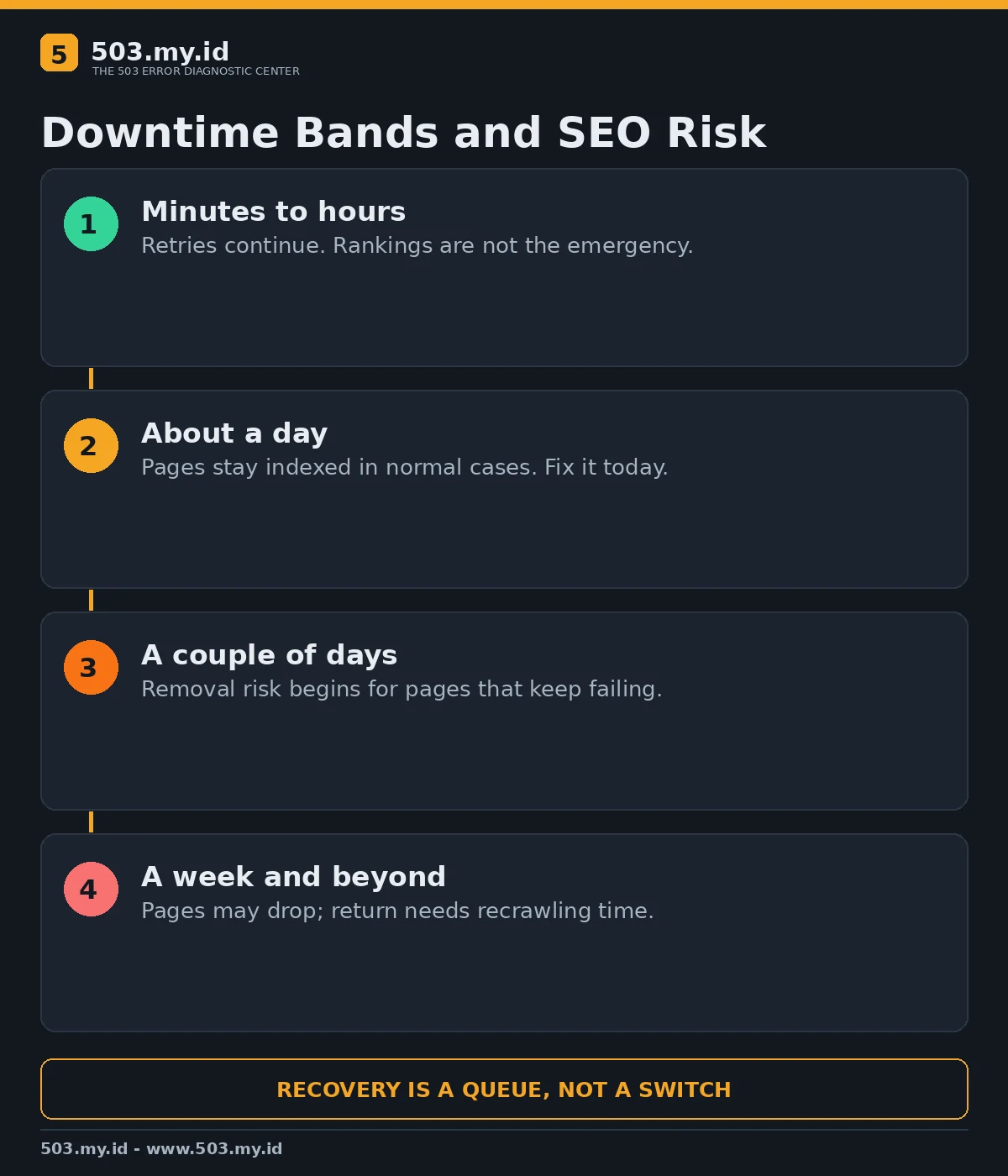
| Downtime band | What Google does | Your move |
|---|---|---|
| Minutes to a few hours | Retries later; crawl rate may dip briefly | Fix calmly; send 503 + Retry-After |
| Up to about a day | Pages stay indexed in normal cases | Fix today; watch Search Console |
| A couple of days | Removal risk begins for failing pages | Treat as an emergency; consider a holding page strategy |
| Several days to a week | Pages may drop; return needs recrawling | Restore anything crawlable; request indexing after |
| Beyond a week | Deeper index loss; slower, uneven return | Rebuild crawl paths; expect a recovery project |
Google’s downtime documentation anchors the middle band: beyond a couple of days, removal risk starts.
John Mueller’s published guidance on closing a site for a day echoes the same shape.
Short and honest beats long and disguised, at every band.
Our Lab: A Client That Honoured Retry-After
The protocol half of this question is testable, so we tested it.
A lab endpoint returned 503 with Retry-After: 2 while a flag file existed.
Our scripted client read the header and waited, instead of hammering.
t=0.054s status=503
t=2.060s status=503
t=4.064s status=200
The third attempt succeeded because the flag was removed during the second wait.
Well-behaved crawlers stretch their retries the same way, which is why the header matters.
What this does not prove: index behaviour. No lab client is Googlebot.
That boundary is why this article carries a scheduled-evidence status, not a victory lap.
The server rule that produced the header:
location / {
    if (-f $document_root/lab503.flag) {
        add_header Retry-After 2 always;
        return 503;
    }
}
Planned vs Unplanned: Google’s Own Playbooks
For planned downtime, Google’s blog recommends 503 with Retry-After from the first minute.
For a full-day closure, its guidance suggests informing users and keeping the pause short.
For a longer business pause, Search Central documents options such as limiting site functionality instead.
Unplanned outages follow the same physics; only your preparation differs.
Rehearsing the maintenance pattern is covered in maintenance without downtime.
The header mechanics live in the Retry-After guide.
Recovery Is a Queue, Not a Switch
The day your site returns, Google still holds yesterday’s picture of it.
Dropped pages re-enter only after a successful recrawl, URL by URL.
Requesting indexing for key pages shortens the queue for those pages.
Internal links from healthy, frequently crawled pages help the queue find the rest.
Budget the recovery days when you estimate an outage’s true cost.
A two-day outage with a three-day recrawl tail is a five-day incident.
What Did Not Work
Searching for one magic hour-count failed; Google publishes bands and behaviour, not a stopwatch.
Treating a 200 “we’re down” page as safer failed too — the notice itself can be indexed.
Our first protocol client ignored Retry-After and retried instantly, proving nothing about crawlers.
Only the header-respecting run produced evidence worth publishing.
And no local test can stand in for weeks of real index observation; we did not fake one.
Decide Your Own Limit Before You Need It
My planning rule: any outage forecast beyond twelve hours gets an escalation and a status post.
Anything approaching two days gets a partial-restore attempt, even an ugly static one.
Write those thresholds into the routine in how to prevent 503 errors.
While down, verify the public answer with our free 503 checker.
FAQ
Is one day of downtime safe for SEO?
Generally yes for indexed pages, per Google’s guidance — fix it that day regardless.
When does Google start removing pages?
The documented risk begins beyond a couple of days of continuous errors.
Does Retry-After extend the safe window?
It makes retries predictable and signals a temporary pause; it is not a free pass.
How long does recovery take after a week down?
Plan for days of recrawling after restoration; dropped pages return gradually, not instantly.
Sources and date: Google Search Central documentation and guidance, plus our Retry-After protocol test, checked 18 November 2026. Index behaviour itself was not lab-tested.
References
- Google Search Central — How to handle planned site downtime
- Google Search Central Blog — How to deal with planned site downtime
- Google Search Central Blog — Closing down for a day
- Google Search Central — How to pause your online business on Google Search
- RFC 9110 §14.3 — Retry-After
Leave a Reply