Two answers at once, 18 November 2026: one target returned 200 to the host probe, 503 to the container probe. Vantage decides the verdict.
Never diagnose from one chair. Check from a second network before touching your server.
- Run the URL through our free checker — an outside vantage point.
- Compare with your own browser on a different network, phone data versus office Wi-Fi.
- Only when both agree it is down do you start server work.
Got a confirmed 503? The 503 Decision Tree takes it from there.
Your client says the site is down. Your screen says it is fine.
Both of you can be telling the truth — that is the uncomfortable part.
“Down” is a report from one network path, not a property of the server alone.
Why “Down” Depends on Where You Stand
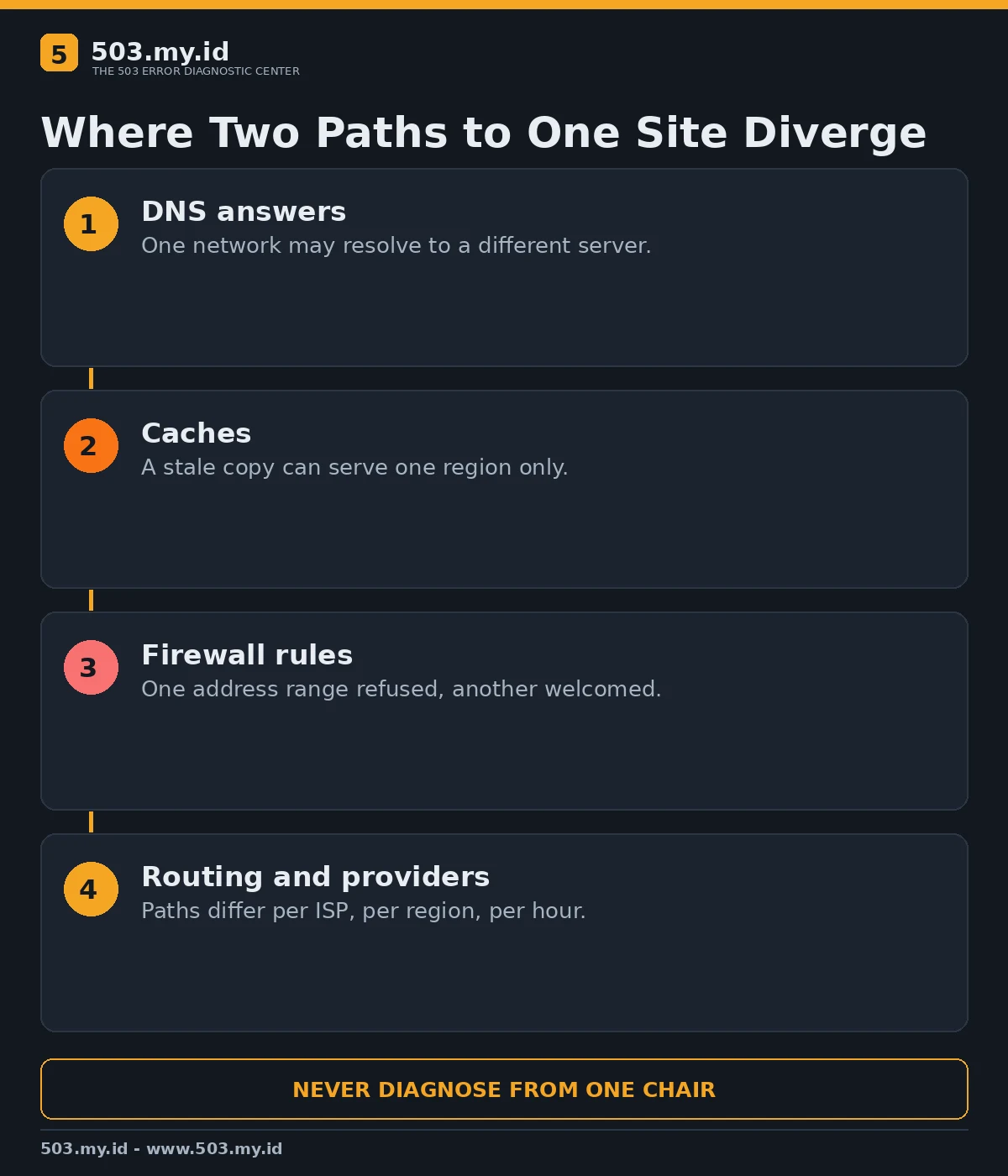
Between any visitor and your origin sit DNS answers, caches, firewalls, and routing choices.
Each layer can differ per network, per region, and per provider.
A firewall rule can refuse one address range while welcoming another.
A stale cache can keep serving a dead page — or a live one — to one region only.
DNS propagation can send one city to the new server and another city to the old.
The diagram shows the four usual suspects on the path:
Our Lab: One Target, Two Answers
We built the smallest honest version of the problem.
An nginx rule keyed on the requester’s source range: our lab bridge range received 503.
Everything else received the normal page.
map $remote_addr $lab_region_block {
    default 0;
    172.17.0.0/16 1;
}
Same second, same target, two probes:
host probe      -> 200 region-ok
container probe -> 503 region-blocked
The server was neither up nor down. It was up for one path and down for another.
Scope honesty: both probes ran on one lab machine, separated by network ranges.
Real geography adds latency and providers, but the mechanism proven here is the deciding one.
Public checkers add the missing ingredient — a genuinely external machine asking on your behalf.
The Two-Vantage Method
- Outside first. Paste the exact failing URL into the checker on our homepage.
- Second network. Load it on phone data with Wi-Fi off; note the status honestly.
- Compare precisely. Same URL, same minute, both results written down.
- Ask a third party in another city when the first two disagree stubbornly.
- Then diagnose. A split verdict points at path layers, not at the application.
Screenshots without URLs or times are how split verdicts turn into arguments.
Record the exact address — a redirect to a login page fools more checks than any outage.
Reading the Four Combinations
| Checker says | Your network says | Likely meaning |
|---|---|---|
| Down (503) | Down (503) | Real outage at or behind the origin; start the runbook |
| Up (200) | Down | Your path is the problem: local DNS, firewall, ISP, or cached failure |
| Down (503) | Up (200) | Regional or provider-specific blocking; gather more vantage points |
| Up (200) | Up (200) | The reported problem is elsewhere: account, page, or device specific |
For the confirmed-outage branch, what causes a 503 error is the next read.
For the only-you branch, clear DNS cache and retest before opening a hosting ticket.
What Did Not Work
Refreshing our own browser ten times proved nothing; the same path gave the same answer.
Pinging the server passed throughout — the machine was fine while one path got 503.
Asking “is it down?” in a group chat produced opinions, not vantage points.
One checker alone also has limits: it is one external location, not the whole planet.
Two independent vantages minimum, three when money rides on the answer.
After the Verdict
Down for everyone: start with logs, status codes, and the decision tree.
Down just for you: the fix lives in your network, cache, or provider — document it for support.
Down for some: collect locations and providers; patterns name the blocking layer.
Keep monitoring afterwards with the routine in the uptime monitoring checklist.
FAQ
Can a website really be down for one person only?
Yes. DNS, caching, firewall, and routing layers can fail for one path while others pass.
How many checkers should I use?
Two independent vantage points minimum; add a third when results disagree or stakes are high.
The checker says up but my client says down. Who is right?
Possibly both. Ask the client for the exact URL and test from their region or provider.
Does a 503 from the checker prove the origin is broken?
It proves that path received 503. A second vantage separates origin failure from path failure.
Sources and date: HTTP status documentation and our split-path lab test, checked 18 November 2026. Lab probes shared one machine across separate network ranges.
References
- RFC 9110 §15.6.4 — 503 Service Unavailable
- MDN Web Docs — 503 Service Unavailable
- MDN Web Docs — HTTP caching
Leave a Reply